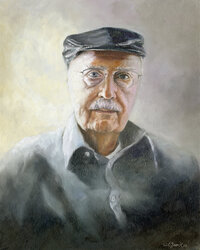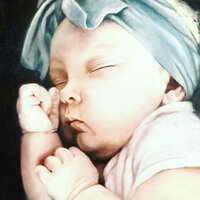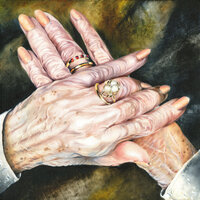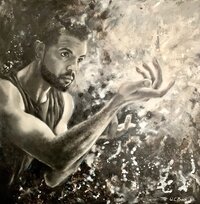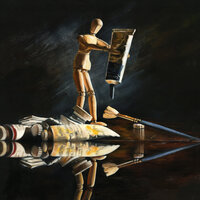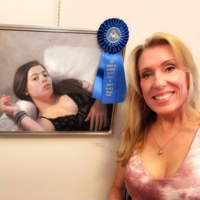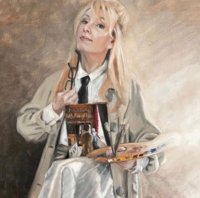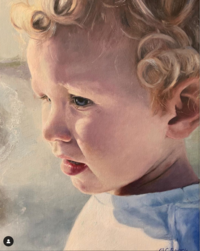


My goal with every portrait is to express the sitter's presence in life. When I feel like the subject can walk out of the canvas, I know I am there.
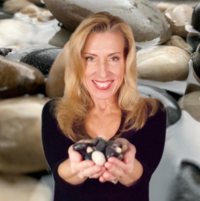
wife, mother, portrait artist
hi, i'm whitney
Connecting with people through the portrait process and getting to know them is a beautiful byproduct of creating a painting.
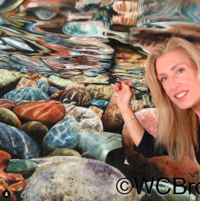
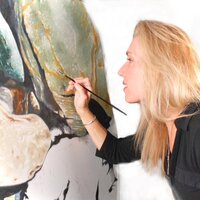
Whitney Brock’s journey as an artist began in New Zealand, where an early education immersed in the arts first shaped the way she saw the world. During three formative years in Auckland, she was introduced to a traditional, observational approach to drawing and painting—an experience she credits with setting the course for much of her life’s work.
In 1987, she continued her studies at Virginia Commonwealth University School of the Arts. There, the emphasis shifted dramatically. The traditional foundations she had encountered in New Zealand met the more conceptual and experimental approach of VCU. That contrast—between disciplined observation and the search for an idea beneath the surface—continues to influence her work today.
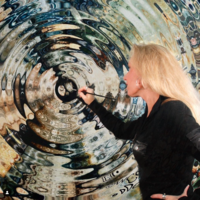
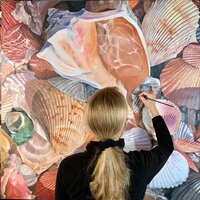
For fifteen years, Whitney worked extensively as a mural painter. The scale and physical demands of that work developed a discipline that would become central to her studio practice: learning to solve problems through painting, to work patiently over long periods, and to remain committed to an image until it was resolved.
Over the years, she continued her education through independent study and instruction with artists including Stephen Quiller, John Lovett, and Patric Whelan. Among her enduring influences are Johannes Vermeer, Norman Rockwell, and the long tradition of realist painters who used technical mastery not simply to reproduce appearances, but to tell human stories.
Eventually, Whitney’s work became increasingly focused on the subject that interested her most: people.
Portraiture brought together the different threads of her artistic life—the observation and craftsmanship of her early training, the conceptual thinking she encountered at VCU, and the discipline developed through years of painting at a large scale. What began as an interest in likeness became a deeper pursuit:
discovering how much of a person can be communicated through posture, gesture, expression, light, and paint.
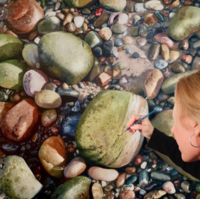
Today, Whitney is a realist portrait painter working primarily in oils. Her paintings are grounded in traditional technique, but her purpose is not simply to document what someone looks like. She is interested in the more difficult question of who they are—and in creating paintings that allow the viewer to feel the presence of another human being.
For Whitney, the journey has never really been about arriving at a particular style. It has been about continuing to look harder, paint better, and find more meaning in the people and stories she chooses to put on canvas.
the journey
– THOMAS MERTON
Art enables us to find ourselves and lose ourselves at the same time.